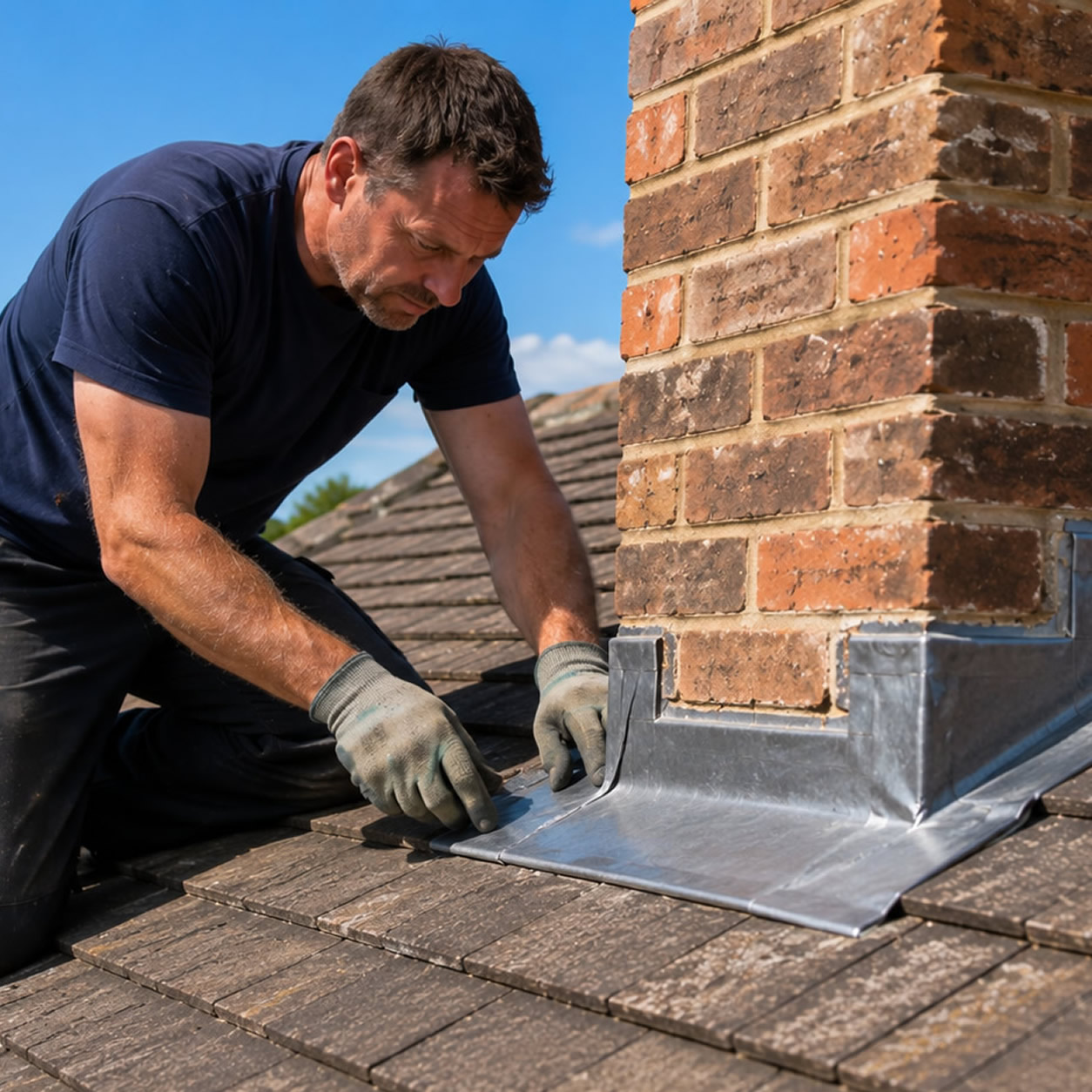
Leadwork & Flashing
Professional leadwork and flashing for chimneys, valleys, abutments, dormers and other vulnerable roof junctions.
Leadwork & Roof Flashing
Professional leadwork protects the most vulnerable parts of a roof. We repair and replace chimney flashings, valleys, abutments, dormer details, box gutters and other junctions where water can enter.
Leadwork services
- Chimney aprons, back gutters and step flashing
- Lead valleys, troughs and box gutters
- Sidewall, abutment and parapet flashing
- Dormer, roof-window and skylight detailing
- Lead soakers beneath slates and tiles
- Lead repairs, renewal and weatherproof sealing
- Leadwork around vents, pipes and roof penetrations
- Inspection of split, lifted or poorly fitted lead
Why leadwork matters
Roof coverings shed most rainwater, but junctions around chimneys, walls, valleys and penetrations need carefully formed flashing. Correctly installed lead guides water safely back onto the roof covering and prevents it reaching the roof timbers or rooms below.
Small defects can cause persistent leaks, stained ceilings, damp roof timbers and damage to plaster or insulation. Repairing the detail properly is usually more reliable than repeatedly applying sealant to the surface.
Common leadwork faults
- Cracked or split lead caused by age and movement
- Lead lifting away from chimney or wall chases
- Short laps that allow wind-driven rain underneath
- Failed mortar pointing above flashing
- Blocked or damaged lead valleys
- Corrosion caused by incompatible materials
- Previous patching with unsuitable sealants
- Water tracking behind poorly formed details
Repair or replacement?
Localised damage may be repaired when the surrounding lead remains sound and correctly detailed. Where the lead is thin, badly split, incorrectly sized or repeatedly patched, replacement is often the more dependable option.
We assess the full junction rather than only the visible crack. This helps identify whether water is entering through the lead, the pointing, surrounding tiles, roof membrane or another nearby roofing detail.
Leadwork for every critical roof junction
The correct lead detail depends on the roof covering, pitch, exposure, junction type and the way water must be discharged.
Chimney flashing
Chimneys interrupt the roof covering and require several connected details. Apron flashing protects the lower face, step flashing follows the sides and a back gutter or saddle controls water behind the stack. All parts must overlap correctly.
Lead valleys
Valleys carry water from two roof slopes and can receive a high volume of rain. Sound support, suitable width, correct laps and clear discharge points are essential to prevent overflow or water tracking beneath tiles and slates.
Abutments and sidewalls
Where a roof meets a wall, lead soakers and cover flashing create a layered weatherproof junction. This protects the roof edge while still allowing normal movement between the roof and masonry.
Dormers and roof windows
Dormers, skylights and roof windows have several vulnerable corners and side junctions. Carefully installed flashings direct water around the opening and back onto the roof surface.
Our leadwork process
- Inspect the affected roof area and trace the likely entry point.
- Check surrounding tiles, slates, underlay, pointing and roof timbers.
- Explain whether a repair or full renewal is recommended.
- Remove failed materials without unnecessarily disturbing the roof.
- Prepare sound support and form the new lead detail correctly.
- Secure, dress and point the lead using an appropriate method.
- Check overlaps, water paths and the surrounding roof finish.
- Leave the work area tidy and explain any maintenance advice.
Benefits to your property
- Reduces the risk of recurring roof leaks
- Protects roof timbers, insulation and internal finishes
- Handles normal thermal movement better than rigid patching
- Improves drainage at difficult roof junctions
- Preserves the appearance of slate and tiled roofs
- Can prevent a small defect becoming extensive water damage
- Provides a more durable solution than temporary sealant repairs
Leadwork and flashing FAQs
Can split lead be repaired?
Some local splits can be repaired, but the condition, thickness and original installation must be considered. Repeated splits or extensive fatigue usually indicate that renewal will provide a better long-term result.
Why does chimney flashing leak?
Common causes include lifted lead, failed pointing, short overlaps, cracked back gutters, damaged soakers or nearby tile and slate defects. A proper inspection is needed because water can travel before appearing indoors.
Can sealant replace lead flashing?
Sealant may provide short-term protection in limited circumstances, but it is not normally a substitute for correctly formed flashing. Movement and weather exposure often cause surface patches to fail again.
Does all old lead need replacing?
No. Sound leadwork can often remain in place. Replacement is recommended when the existing material is badly split, incorrectly detailed, too thin, extensively patched or no longer securely fixed.
Do you repair lead valleys?
Yes. Valley work may include clearing obstructions, repairing local damage, renewing failed sections or replacing the complete valley where its condition or layout makes repair unsuitable.
How do I request a quote?
Send your name, telephone number, property area and a brief description of the leak or leadwork problem. Photographs are useful where available, but an on-site inspection may still be required before the work and price can be confirmed.
Leadwork & Flashing Gallery
Scroll through photographs from our leadwork & flashing work.


Leadwork & Flashing Videos
Scroll through project videos uploaded for this service.
Request a free roofing quote.
Clean, simple and quick. Send the basics and ATHLONE ROOFING will receive the enquiry straight away.